The current energy crisis is already considered the worst the world has seen for decades by energy experts.
Is it a surprise? To savvy investors, it's certainly not. Some of the most important signals were already there before the current Middle East war even began.
At l’Université de l’énergie de demain, hosted earlier this year in February by Mouvement Impact France with Flavie Houdin, our colleague Karl-Johan Brandeskar attended a discussion that took place before the escalation. What stood out then still holds today: the real shift was never just about the crisis, but about the underlying trajectory.
Time for a team take-over with Karl’s take on the matter.
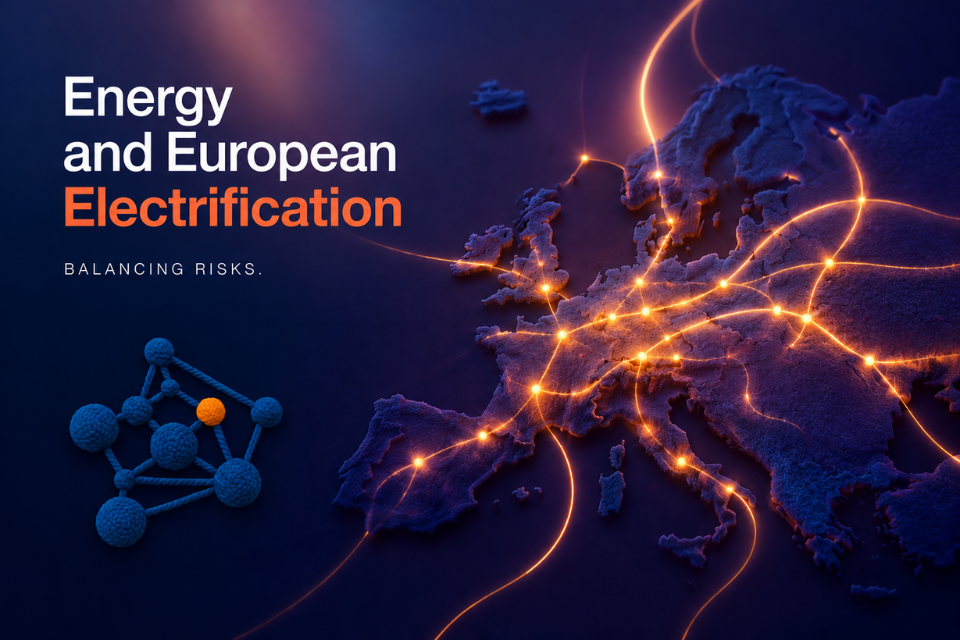
"Europe’s transition to renewable energy is, at its core, a story of electrification. It addresses some of the continent’s most pressing structural challenges: decarbonising industry, reducing dependence on imported fossil fuels, and limiting the price volatility that has strained households. Electrification is also central to European sovereignty. But it is not without trade-offs.
What tends to receive less attention is how electrification, as it stands today, shifts rather than removes dependency. An electrified system runs not on fossil fuels, but on semiconductors, batteries, critical minerals, software, and digitally managed infrastructure. Without sovereignty in these auxiliary industries, dependence moves from fuels to technologies, many of which are produced and controlled outside of Europe.
The implication is not to slow down the transition, but to understand it more clearly. Accelerating electrification without the necessary industrial capacity context risks replacing one vulnerability with another. Interdependencies evolve quickly, and in a geopolitical context, they can become structural constraints.
For investors, this adds different layers of complexity. 'Future proof' low-carbon business models cannot be addressed through the single lens of electrification and sovereignty strategies cannot focus purely on decoupling from imported fuels. The challenge is balancing risks: reducing exposure to fossil fuel volatility while not overexposing portfolios to concentrated technology supply chains and external policy environments.
This is not a comfortable discussion, but it is a necessary one.
It starts with a few critical questions:
• Which supply chains and trade dynamics are my assets embedded in?
• Am I substituting fossil fuel dependency with foreign tech dependency?
• Given the risk of dependency substitution, how resilient are the business models in my portfolio? Are they fit for the next ten years?
Electrification remains essential. The question is how to move forward while recognising the trade-offs and managing them proactively rather than reacting once the risks materialise, or worse, assuming they'll disappear."
Europe’s energy transition: from fossil fuel dependency to technological sovereignty
In this team take-over, Karl-Johan Brandeskar explores the hidden dependencies behind electrification and why investors must look beyond decarbonisation to assess supply chain resilience, technological sovereignty and the long-term viability of low-carbon business models.